
International Day of Nonviolence: What Nonviolence Means for Sacred Activism
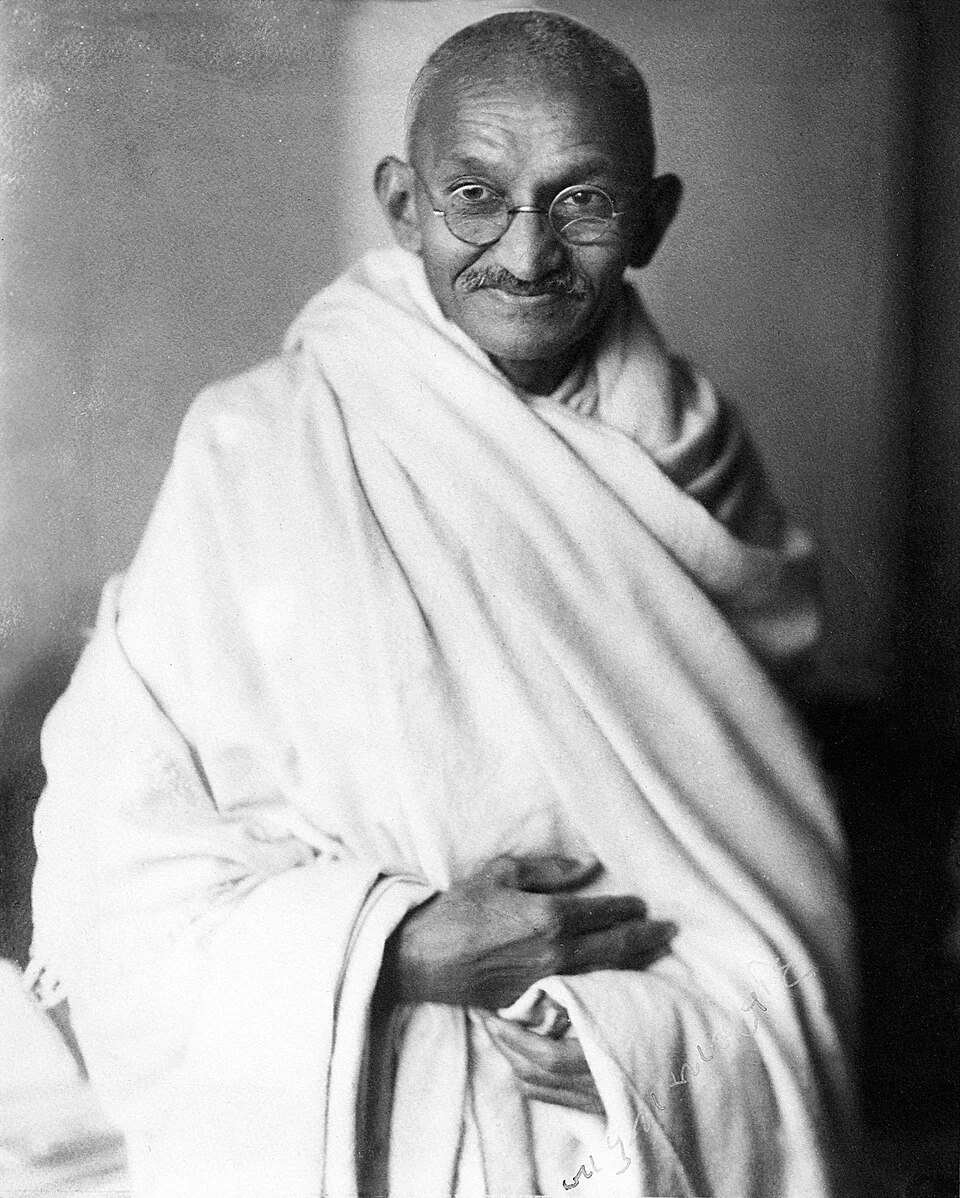
Mahatma Gandhi, the leader of India's independence movement.
The concept of non-violence has played an important a role in resistance movements throughout history - and is a central precept for Sacred Earth Activism (SEA).
This makes it important to mark the United Nations' (UN) International Day of Non-Violence (2 October), which was established in 2007 on the anniversary of Mahatma Gandhi's birthday. Gandhi was a pivotal leader in protests against British rule in India during the first half of the twentieth century, introducing an ultimately successful, nationwide campaign of passive resistance.
His approach has subsequently influenced nonviolent individuals and movements advocating civil rights and social change around the world. This includes Martin Luther King Jnr and the US Civil Rights Movement in the 1960s.
In the UK, nonviolent direct action has been a significant part of peace, anti-nuclear, and environmental resistance initiatives for many years. These include the Campaign for Nuclear Disarmament (CND), the Greenham Common protest against a US nuclear missile site in the UK, and later environmental movements, such as Extinction Rebellion.
Nonviolence is also central to the approach we take within SEA. But our activism includes not just protest and direct action, but also ritual, prayer, ceremony and magical practice. So, what does a commitment to nonviolence mean in this context?
What does violence mean within sacred activism?
If we are using sacred or magical practice as a form of activism, we are doing so because we believe it can have a real impact in the world. If that is the case, then questions of violence and harm must apply to our magical activism too. But what might magical violence actually look like?history – and
Typically, it would take the form of cursing or hexing, magical activity that is deliberately intended to cause harm or misfortune. There has been endless debate within Pagan, witchcraft and magical traditions around whether such curses are ethical. Some practitioners are strongly opposed, while others believe curses can be ethically justified, particularly against those perceived to be causing harm or oppression themselves.
But for SEA, the question is a slightly different one. Our dilemma is, if we have committed to nonviolent principles, how should that commitment inform our sacred activism?
Curses, hexes and bindings as political activism
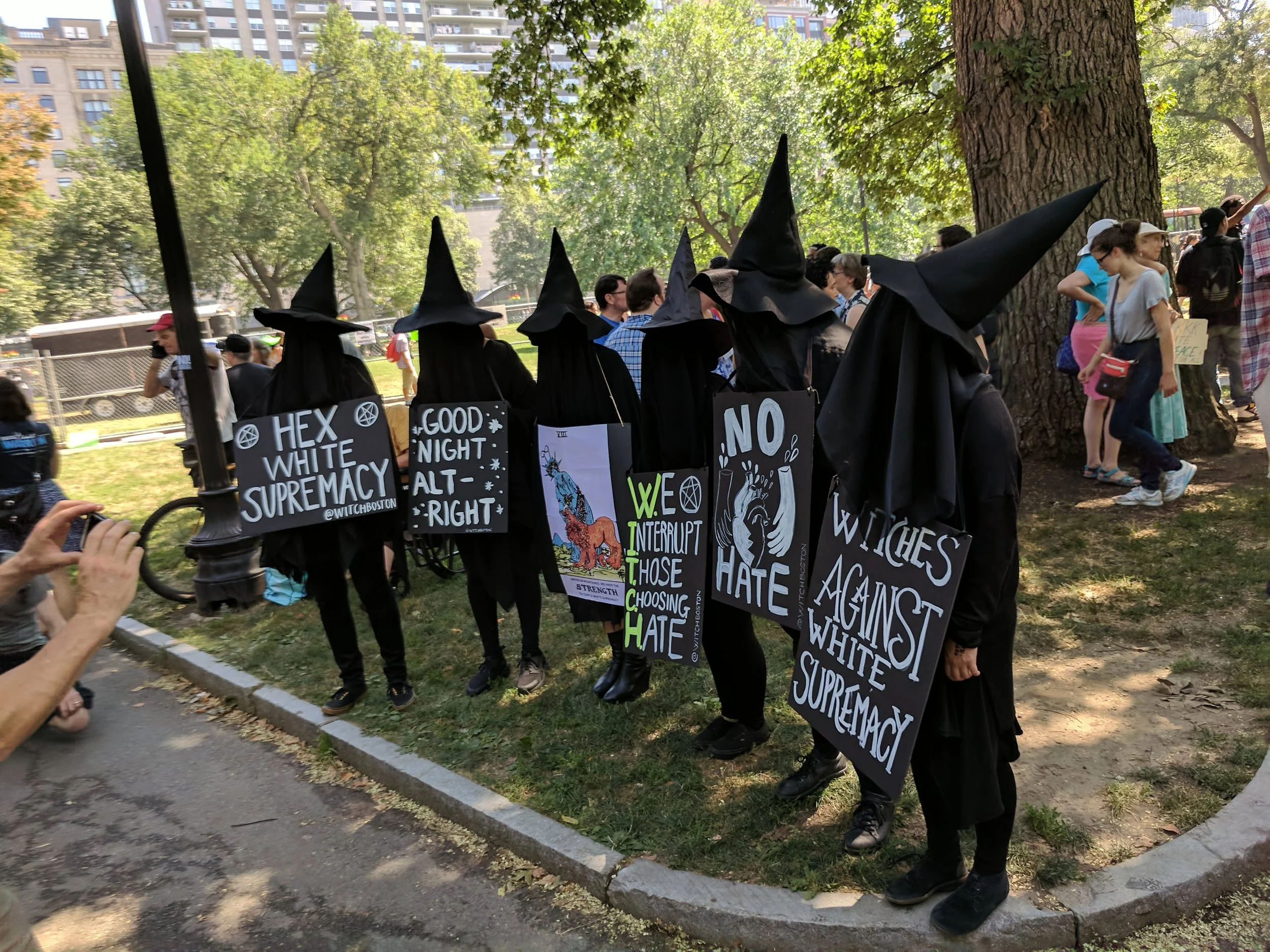
Members of W.I.T.C.H. Boston holding signs counterprotesting the Boston Free Speech Rally on August 19, 2017 (By GorillaWarfare - CC-BY 4.0)
Magical practices have been used as explicit forms of political protest and resistance for years. One famous example was the Women's International Terrorist Conspiracy from Hell (WITCH), which sprang out of the second-wave US feminist movement. One of their most famous early actions involved performing a public 'hex' at Samhain/Halloween in 1968 on Wall Street to protest against corporate capitalism and the patriachy. While this may have been wholly or partly theatrical, rather than a genuine ritual, the fundamental ethical question still applies.
A more recent example saw occult author Michael M Hughes organise a mass magical working to 'bind' Donald Trump in 2017. The idea was to prevent Trump and his supporters from doing harm. Hughes described the action as a binding rather than a curse or hex as the aim was to restrain them rather than cause them hurt.
But others felt the distinction was not enough to make the magical act ethical or, for that matter, non-violent.
This distinction itself points to an interesting question for sacred activists, highlighting, as it does, an ethical grey area on which many magical practitioners disagree: is magically attempting to prevent someone from doing something harmful, thereby restricting their will, necessarily violent? And how does it compare to hexing and cursing?
A second example of an action, again organised by Michael M. Hughes, illustrates another quite different way in which magical practice was employed as a form of political activism. Following Russia's invasion of Ukraine in February 2022, magical activism was used as an explicit element of political resistance.
#HexPutin was a global mass ritual to explicitly curse Russian President Vladimir Putin and protect Ukraine. The first coordinated action took place on 2 March 2022 and was later repeated. The aim was to have Russian soldiers refuse to fight, see Russians rise against Putin and remove him from power, and ultimately to free Ukraine.
Other magical actions have also been directed towards stopping particular actions, projects, policies, or sources of harm, or towards protecting those affected by them. In other words, there is a spectrum of activity here, ranging from intending opponents harm to enabling protection and positive change.
Starhawk, Reclaiming and magical activism
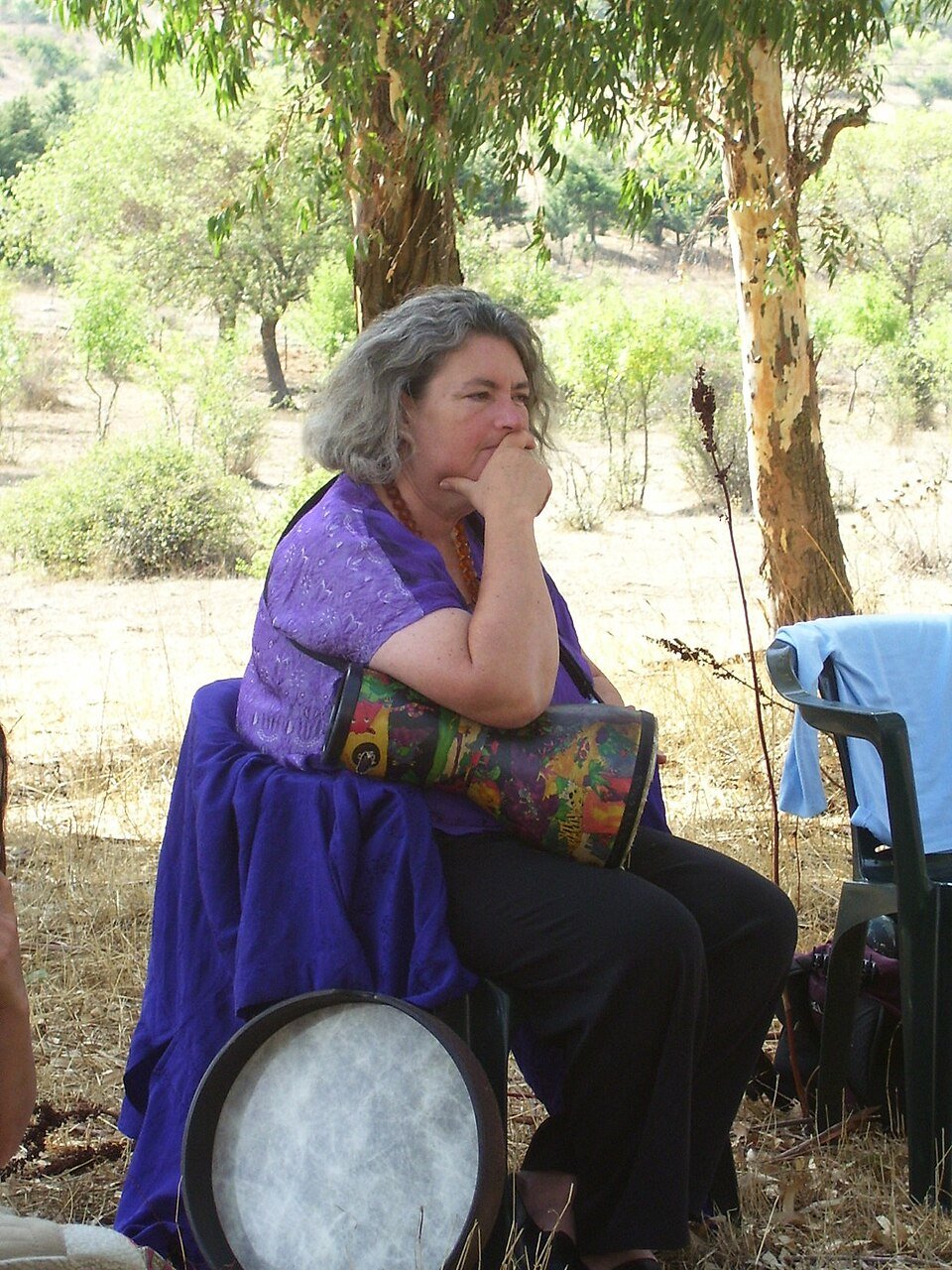
Starhawk, pagan and eco-activist (By Dedda71 - CC-BY 3.0)
Different magical traditions and practitioners draw the ethical boundaries between these things quite differently. SEA has drawn inspiration from the work of Starhawk and the Reclaiming tradition. Reclaiming is a blend of practical magic with frontline activism and direct action, which the movement describes as 'magical activism'.
From early on, Reclaiming affinity groups participated in nonviolent direct action to protest nuclear power and weapons, later becoming involved in Occupy Wall Street and other movements.
In Starhawk's seminal work Spiral Dance, she discusses the ethics of hexing, cursing, and binding in a political activism context. She acknowledges that the witch community holds no single position on the matter. While some traditions prohibit hexing and cursing, others argue that destructive magic is not necessarily the same as harmful or unethical magic. The question here is one of judging ‘who is presenting a danger to others'.
But Starhawk herself is cautious about hexing. Her view is that what we direct towards others also affects ourselves. This is because we participate in and embody the energy we generate.
She does not believe that magical practice should never be directed against an individual's actions though. Indeed, Starhawk points to those who present a danger to others and may therefore need to be stopped. This could include political leaders and institutions that cause harm.
But her preferred magical response is to create a binding spell to prevent them from causing damage rather than issue a curse intended to inflict harm on them. But even in this instance, Starhawk clarifies such action should not be undertaken lightly.
She makes a distinction between stopping genuine harm and using magic against someone simply because we dislike them, they annoy or inconvenience us. The wider principle here is that magic should not be about gaining "power over" others but should instead be about developing "power-from-within".
In other words, committing to magical nonviolence may still include actions to stop, bind, prevent, or restrict harmful action as long as they are not intended to make someone else suffer. Nonviolent magical actions may interfere with the operations of institutions of power, though.
Nonviolence does not mean passivity
Also important to note though is that nonviolence does not mean passivity or failing to stand up for the things we care about. It also does not mean avoiding conflict or refusing to put pressure on those causing harm.
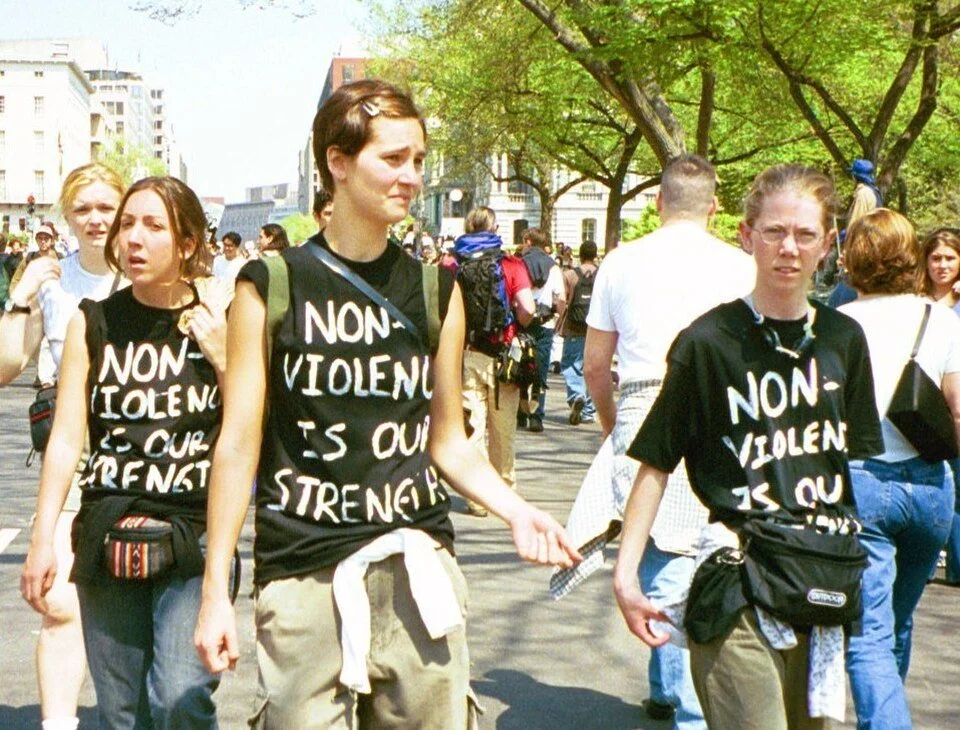
How the UN describes nonviolent resistance is as being about rejecting physical violence to achieve social or political change. It divides nonviolent action into protest and persuasion, non-cooperation, and nonviolent intervention. This can include marches and vigils but blockades and occupations too.
These may be disruptive, confrontational, and directly intended to stop something from happening. But crucially they are not based on causing physical harm. Instead, they are about finding ways of opposing others without violence.
This distinction provides a helpful way of considering the difference between hexing and binding. If nonviolent physical activism can deliberately block, restrict or prevent something without becoming violent, the same could be said to be true of sacred and magical activism.
A binding that is intended to prevent somebody from causing harm is conceptually similar to a physical blockade. Both are directed and explicitly try to interfere with, or stop, something from happening. A hex or curse, on the other hand, are intended to make someone suffer, become ill, or experience misfortune. This means they cannot be described as nonviolent.
Of course, physical activism and sacred practice are not directly equivalent, and the UN's definition covers political action rather than sacred activism. But it is important to consider such distinctions to develop our own principles of non-violence.
Committing to nonviolence does not mean we cannot try to stop something we believe is causing harm. Instead, it asks us to consider how we attempt to stop it. We can be active, directive, obstructive, and firmly opposed to something in our ritual and ceremonial actions without intending to harm other people.
"Power for" and "power against"

Joanna Macy (By Adam AvRuskin - CC BY-NC-SA 2.0)
Some argue that magical action against someone or something will have the unintended consequence of causing harm. This would mean we should always steer away from it, focusing instead on putting our energy towards what we are for - and this is important and powerful work.
If all our activism is focused on what we oppose, we may lose sight of the world we really want to create. This point is fundamental to Joanna Macy’s Work That Reconnects and the compass setting we choose to follow in carving a path into the future.
From this perspective, the focus of our ritual activism should be to give energy to the alternatives, relationships, and possibilities we wish to bring into being. Rather than focus solely on the things we oppose, it means creating a vision, and rituals, for what we want to bring into the world. This includes healing, restoration, justice, peace, protection, renewed relationship with the Earth, and the flourishing of both the human and more-than-human world.
But it does not imply we should avoid understanding what we are against either. We can stand against the destruction of woodland, river pollution, the persecution of communities, warfare, or any other form of injustice. We can hold ceremony or work ritually for something to end, change, be exposed or prevented.
Nonviolence in SEA
To this end, SEA holds rituals and ceremonies that “dream awake the world we want to see” and that “co-create the emerging world”. Our focus is on the positive visions we wish to manifest in the world.
But our rituals and ceremonies also speak directly to what we are resisting. We call for destructive actions to stop, harmful practices to end, places and peoples to be protected. This approach is consistent with how nonviolence is understood within wider activist movements.
As a result, our rituals do not always need to be gentle, peaceful, or solely about sending out positive energy. They can be fierce, active, directed, and resistant. We can name what we stand against as well as what we stand for. We can also be specific about the outcomes we want our sacred activism to support.
The UN's International Day of Non-Violence is a chance to celebrate this approach as an ideal. It also provides an opportunity to consider what such a commitment means for us as sacred activists.
In activism more generally, nonviolence does not mean standing aside. Within sacred activism, it should not involve passive ritual practice either.
We can be clear about what we oppose. We can direct our spiritual and magical practices towards resistance, prevention, and change. But if we are to maintain our commitment to nonviolence, we should be mindful of it in a ritual activism context too.
(by Carolmooredc, CC BY-SA 3.0)