
Weaving Ceremony with Pride: Honouring our Queer Ancestors
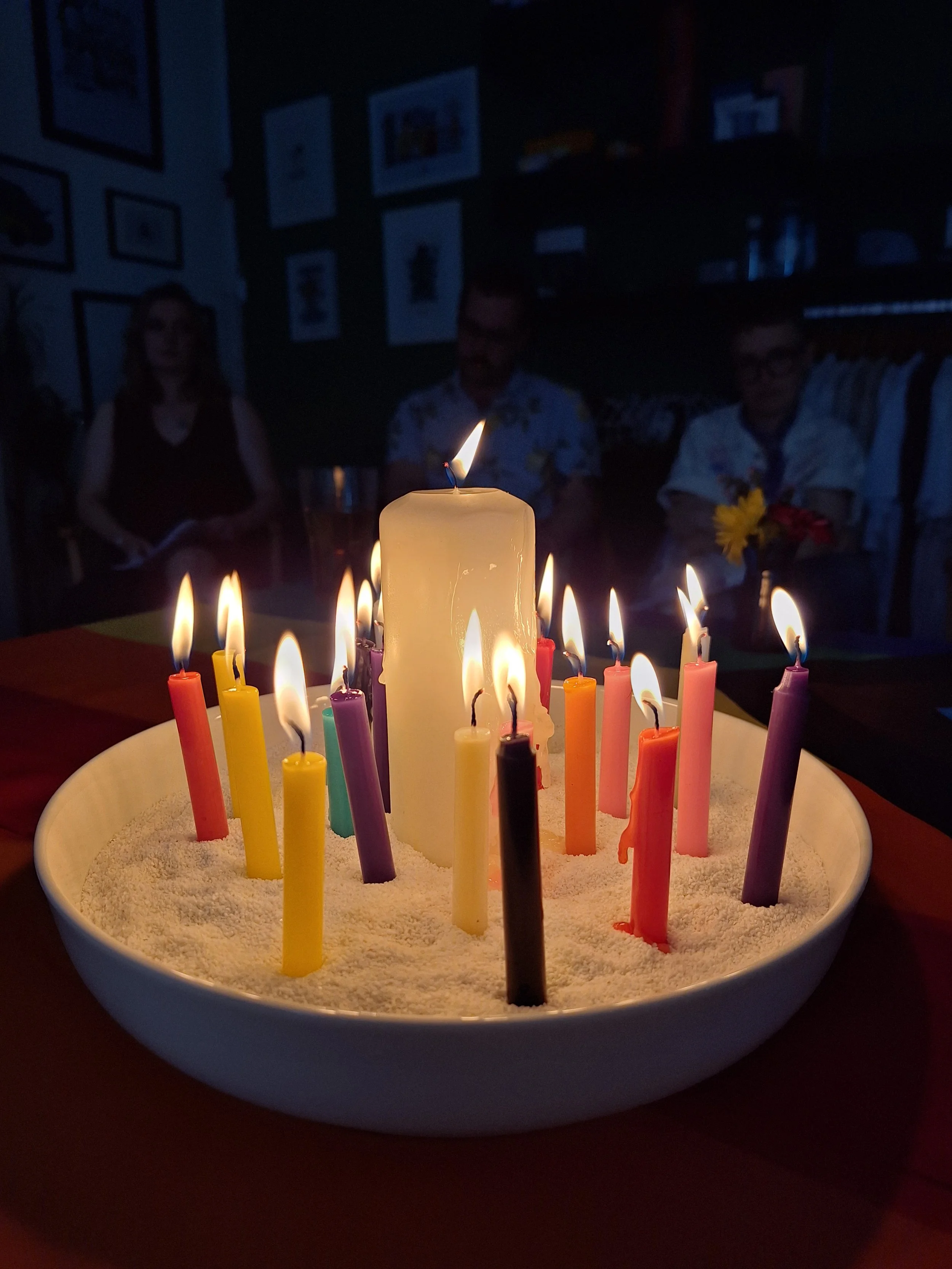
While it may not currently be a widespread practice during Pride Month (June), creating ceremony to honour our Queer Ancestors and invoke their protection is a beautiful way of linking us all to our history.
The idea came to my friend Mich and I last June. We wanted to offer something different in our city, which has its own growing Pride event, a community Pride, and four weeks of activities in the ‘queer district’.
Both of us regularly work with writers, especially members of the LGBTQ+ community. Over recent years, several key themes have come to light: the need for more intergenerational sharing, and a desire to know more about local, national, and international queer history. But there is also an increasing sense of unease and the need for more care and protection in light of legal changes, a shift in media narratives, and the rise of the far right.
To address these issues, we organised three events. The first was a writers' workshop. Here, people were invited to write in memory of their Queer Ancestors. These included friends and family they had known directly, well-known historical figures, or lesser-known individuals from the past.
We collected a host of stories about queer folk from around the world and across the span of time. What amazed us was how few of these people we had heard of and just how exciting such glimpses into the past proved to be.
People wrote poems and flash stories and together we shaped the words to a prayer to our LGBTQ+ Ancestors. We encouraged people to share these and other Ancestor tales at a storytelling event a few weeks later to wrap up our Pride celebrations.
In ceremony with our Queer Ancestors
In between these two events, we held a ceremony for our Queer Ancestors. This was inspired partly by the brilliant work of Trans Rite in honouring their transgender dead, and partly by a desire to protect folks attending Pride events and marches.
Being unsure of how many people would attend an event that felt so different to the others on offer, we set out a circle of chairs, made a central altar draped in Pride flags (the traditional, the progress and the trans Pride), and waited to see who would show up.
With the rise in discrimination and threats to the community in recent years, especially against our trans siblings, it felt important to enable strong protection for those attending Pride events and protests. Therefore, as part of the ceremony, we drew on folk customs to create protective charms.
As many as 20 people attended, which was more than expected, so we are repeating the event this year. Each came with their own identity, set of beliefs, and past experience of ceremony, but everyone had a shared desire to honour the past.
If you would like to recreate our ceremony or the charms we used during last year's Pride season, either solo or as a group, please feel free to adapt the below or use it as a guide:
THE CEREMONY
OPENING
Begin by grounding and clearing the space using visualisation and juniper smoke. Ask Spirit and other positive forces for their blessings and protection.
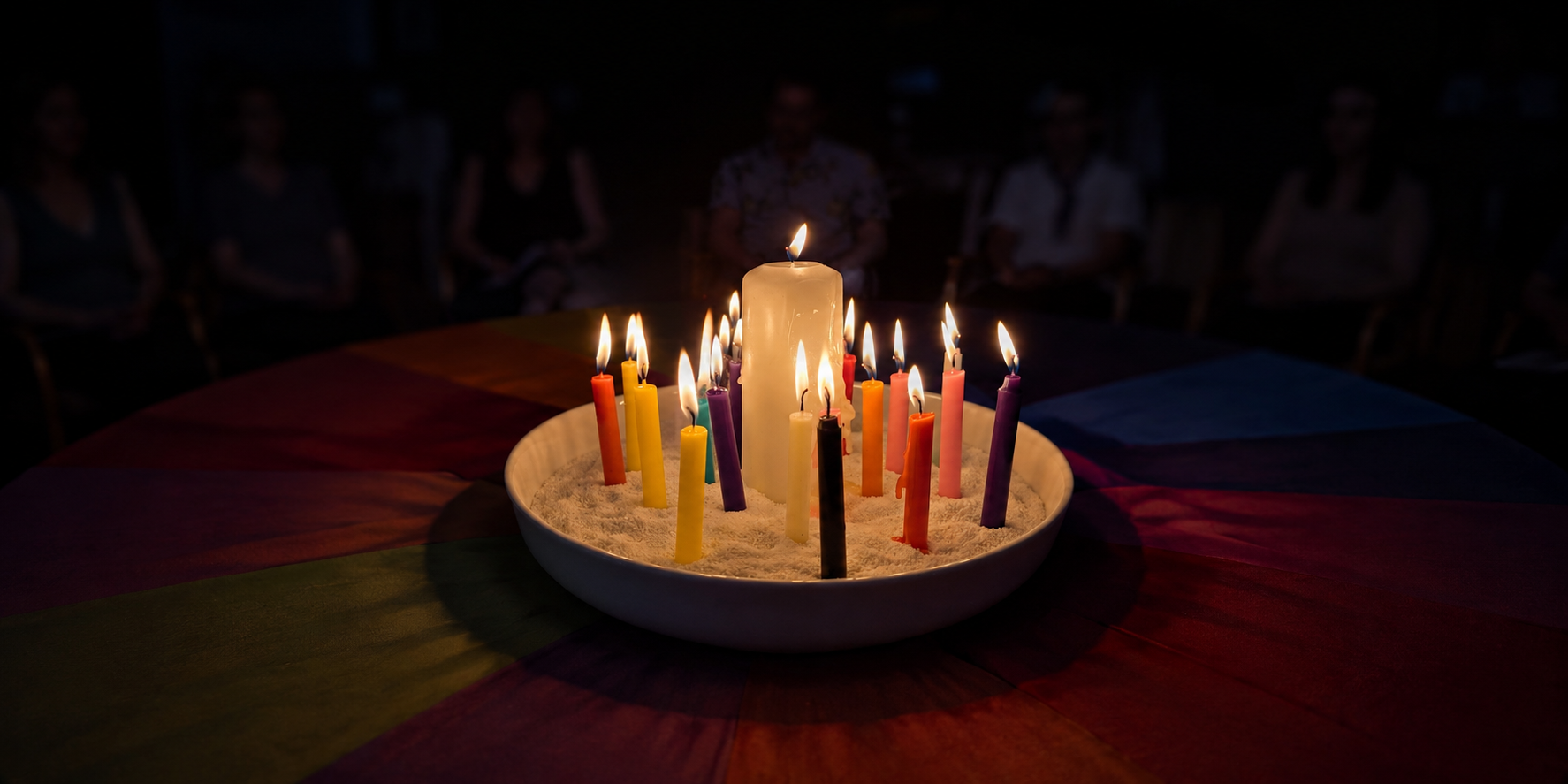
We had chairs in a circle with a central table as an altar, decorated with three Pride flags; a central, white candle, and a large bowl filled with sand and small, unlit, colourful taper-style candles within it.
Note: Ensure the tapers are not too close to the central candle or each other!
Call to the four directions for peace, using the wording from modern Druidic ceremonies:
May there be peace in the North
May there be peace in the South
May there be peace in the West
May there be peace in the East
ALL: May there be peace throughout the whole world.
Create sacred space by joining hands, one by one. Each person says:
Hand to hand, I join this circle.
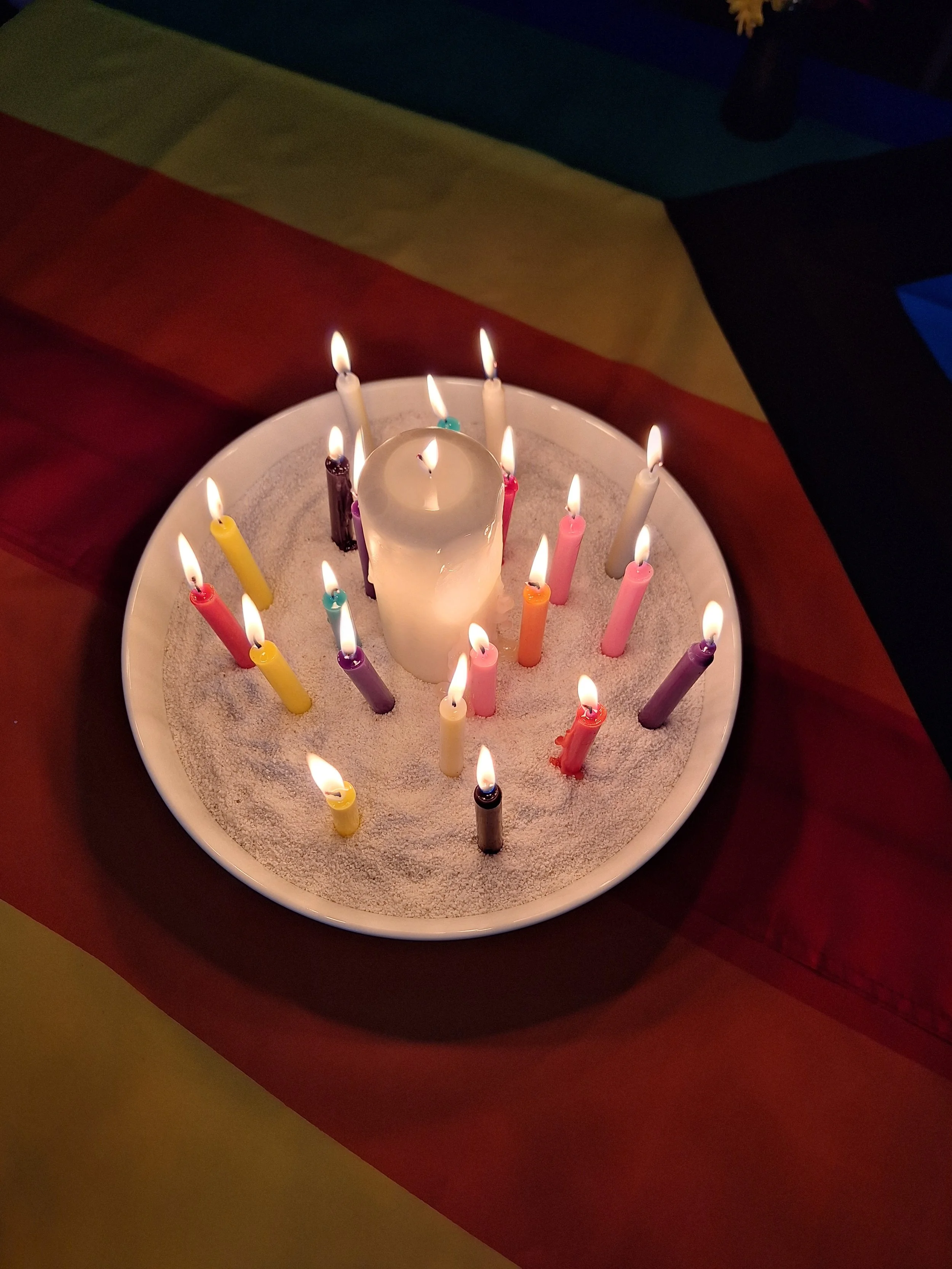
Light the central candle, and say:
We light this candle to mark the start of our ceremony to remember our Queer Ancestors: Lesbians, Gays, Bisexuals, Trans, Queers, Questioning, Intersex, Asexuals, Pansexuals, Two Spirit, Non-binary, those named and unnamed who are connected to us.
Here at the centre, on the altar, we have two Pride flags and flowers with LGBTQ+ associations, including green carnations for Oscar Wilde.
And we remember the artist, designer and activist Gilbert Baker, who designed it. A flag first unfurled at the San Francisco Gay and Lesbian Freedom Day Parade on the 25th of June 1978.
We remember the meaning of these colours:
Red, for life
Orange, for healing
Yellow, for sunlight
Green, for nature
Blue, for serenity
Purple, for spirit
Light blue, pink, white, for our trans siblings
Brown, for our global majority siblings
Black, to remember those who died of HIV/AIDS.
Tonight we remember them, and all those represented by these colours who are no longer with us.
THE FOUR QUEERS INVOCATION
We chose to honour four local, national and international Queer Ancestors who meant something to us, represented the diversity of the community, and connected to the Celtic associations of the sacred directions. You may like to personalise this element based on your own location or background.
EAST:
We welcome the memory of PRUDENCE DE VILLIERS, (a local lesbian woman who ran a queer bookshop in our home city with her partner)
And remember the power of words, of stories, of history,
Of the inspiration of thoughts and ideas,
Of a place where you can meet inspiration and find others like you.
Place a queer history book on the altar.
SOUTH:
We welcome the memory of MARK ASHTON, (a gay activist best known for co-founding Lesbians and Gays Support the Miners)
And remember the power of action, of solidarity, of struggle,
Of the flames of anger against injustice and of hope for a better world,
A place where you can connect, build and act together side by side.
Place a lamp or lantern on the altar.
WEST:
We welcome the memory of PEARL ALCOCK, (a Jamaican-born, bisexual Black British artist, who ran an unlicensed bar for the community in Brixton)
And remember the power of joy, of emotions, of love,
Of the waters of healing and of deep emotion,
Of a place where you can laugh, love, weep and share together.
Place a pint of beer on the altar.
NORTH:
We welcome the memory of MARSHA P JOHNSON, (a key figure and activist in the 1960s and 1970s gay rights movement in New York, she was present at the Stonewall raid and worked for trans, homeless and HIV+ people in the city)
And remember the power of bravery, of fighting spirit, of strength of character,
Of the earthy foundation we stand upon and grow from,
Of a place where you can fight and a place where you can dance, grounded in who you are.
Place a brick on the altar.
NAMING AND CANDLE RITUAL
Let’s speak aloud the names and stories of the ancestors we want to remember this evening. Knowing they are but a few among the many we also honour tonight.
Saying their names out loud and sharing their stories means they will not be forgotten,
Named and remembered, they will never really be dead, but remain alive, in and among us.
Each member of the group shares the name or names of Queer Ancestors they would like to remember on this night:
“I would like to remember…”
They could also share a poem or story, a photo or image.
Note: Consider time-keeping issues based on the number of participants.
Each person takes a taper and lights it from the central candle, before adding it to the large, central bowl filled with sand.
CONTEMPLATION
Spend two minutes in silence and contemplation.
MAKING QUEER EYES
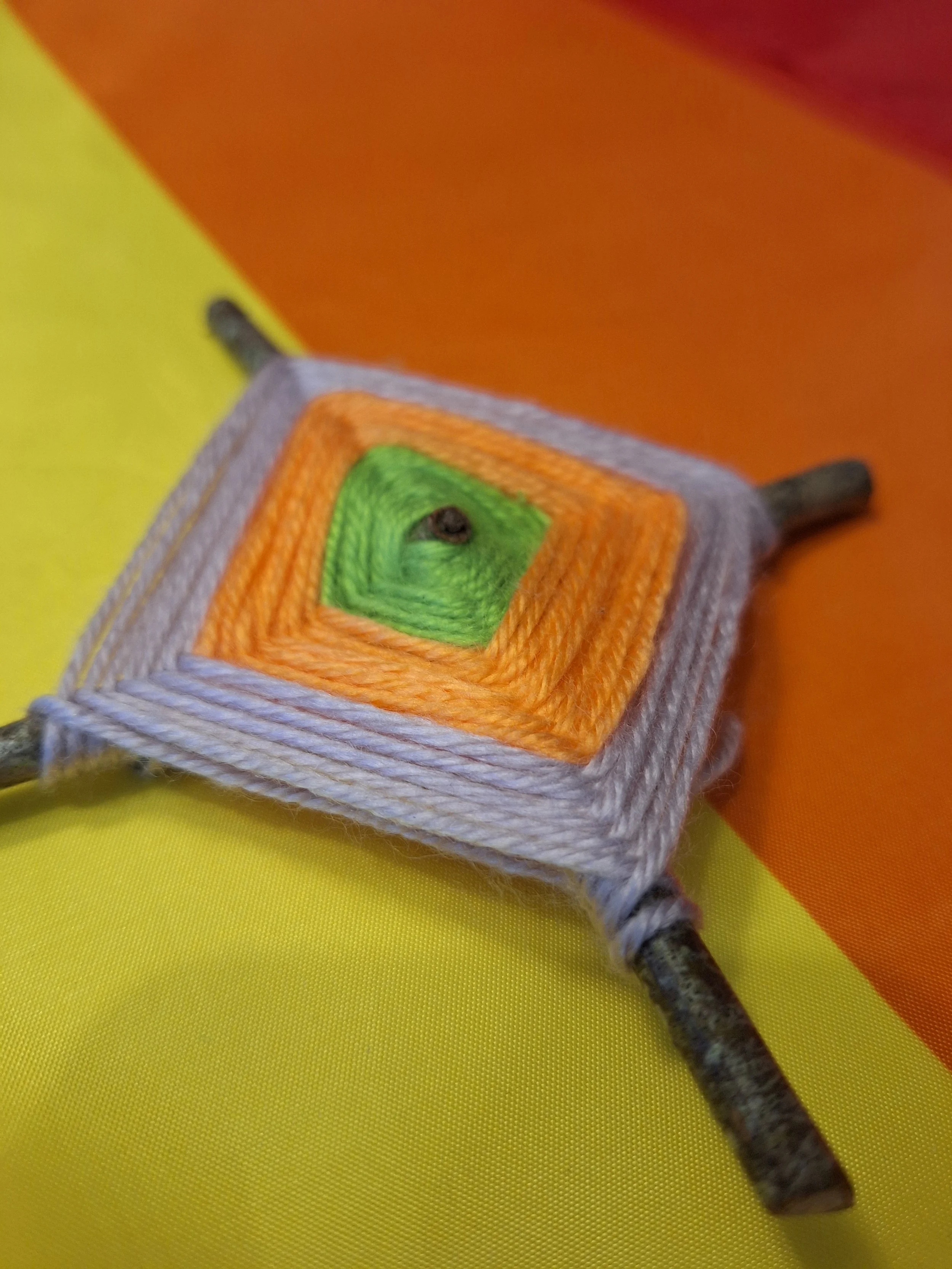
While we think of all these wonderful human beings, we invite you to join us in some symbolic crafting, to make a Queer Eye to take away either for yourself or to give someone as a gift.
Two sticks of rowan are an old symbol on these islands of protection when tied together with red thread. For as our ancestors needed protection, so too do we now in this present, so too will our community in the future.
Threads of bright Pride colours to weave our lives with.
You are invited to choose colours that represent the Ancestors you want to remember tonight, to symbolise the qualities that you would like to take into the world yourself.
Instructions:
Take two short pieces of Rowan twig (ideally straight and around 15cm), oak, silver birch or other tree with protective associations. Choose lengths of coloured wool (see the colour associations above) based on the qualities you want to carry with you at Pride events. We suggest using red due to its historic use in Rowan protection charms.
Use the first strand of wool to tie the two twigs together in an X or cross shape. Then weave the wool around the twigs by looping it around the front and back of one of the four arms. Run the wool across the front to the next arm, repeat a loop around the front and back of the next arm, run the wool to the front of the next arm, and so on. Doing so will build a flat square of wool on one side of the charm. To change colours, simply tie off the current strand on an arm, tie a new colour to that arm, and continue the weave.
We blessed the charms on the altar. Participants then took them to carry at Pride marches, protests, and events beyond Pride month.
THE PRAYER
We encourage you to write your own version of a Queer Ancestors' prayer using the following format:
This is a prayer for…
The ones who…
We thank you for…
We offer you…
We will…
CLOSING
NORTH: We give thanks to the memory of Marsha P Johnson
WEST: We give thanks to the memory of Pearl Alcock
SOUTH: We give thanks to the memory of Mark Ashton
EAST: We give thanks to the memory of Prudence De Villiers.
As these lights for the ancestors are extinguished, we carry the light in our hearts and minds and memories.
Ancestors, we remember you tonight and every night.
The candles are extinguished.
We invite you to hold hands again or hold the intention of connection in your heart.
Thank you, everyone, for being here tonight and sharing.
Let’s hold hands one last time and then release hands, one by one.
EVERYONE: Hand from hand, I leave this circle (or heart from heart, I leave this circle.)
Let us take the lessons of those who came before us out into the world.
END
The space can be kept open for a short while after the ceremony for those who would like to sit, chat, reflect, and adjust before heading back out into the world.
Additional notes:
When leading and holding this ceremony, be clear that it is intended to honour, send love to the Ancestors and evoke their memory. It is not about invoking or summoning Ancestors into the space, especially unknown ones, those who have suffered, or those who are not directly known to you.
If adapting the ritual, keep protective, grounding, and guardianship elements in place. Offerings to the Ancestors in the form of praise words, poems, prayers, flowers etc should also be retained. In the case of flowers, offer them back to the land afterwards. Ensure you give gratitude to the Ancestors, and any helping forces you have named.
Our ‘Queer Eye’ protection charms seek to honour traditional folk practices and adapt them for our times. The act of tying rowan protective crosses with red ribbon or wool has been recorded in Scotland and England since the early 1800s but may stretch back much further.
In recent years, 'Brigid’s Eye' variations of Brigid’s crosses, made with wool around two sticks in a cross shape, have been added to the repertoire of traditional reed crosses. Both may well be influenced by Ojo De Dios (God’s Eyes) made by indigenous groups in the Americas, including the Huichol, Aymara and Navajo peoples who we would like to honour and acknowledge here (and during the ceremony).