
From climate despair to Active Hope
“The future is dark, with a darkness as much of the womb as the grave.”
Rebecca Solnit: Hope in The Dark/Looking Into the Darkness
Since reading 'Hope in the Dark' some years ago, the above quote by US author and activist Rebecca Solnit has stuck with me. It is reminiscent of the Tibetan Buddhist concept of the Bardo, a liminal space between death and rebirth. A gap between the worlds where change occurs, it is a place full of possibilities.
It is also the darkness that nature poet and philosopher Henry David Thoreau speaks of when he says:
“I believe in the forest, and the meadow, and the night in which the corn grows.” Henry David Thoreau: Walking
Exploring such ideas further to mark the United Nation's International Day of Hope (12 July), it seems clear that such hope is linked to the darkness. In the dark, things - which include our plant kin - germinate, coming up into the light as new growth.
In the context of The Work That Reconnects (WTR), which was initiated by eco-philosopher, environmental activist and author Joanna Macy, this means that facing and acknowledging our pain and despair is essential for personal growth. Doing so leads us to a deeper understanding of these emotions and, ultimately, generates a sense of empowerment. In this way, 'Passive Hope' becomes 'Active Hope'.
Passive Hope becomes Active Hope
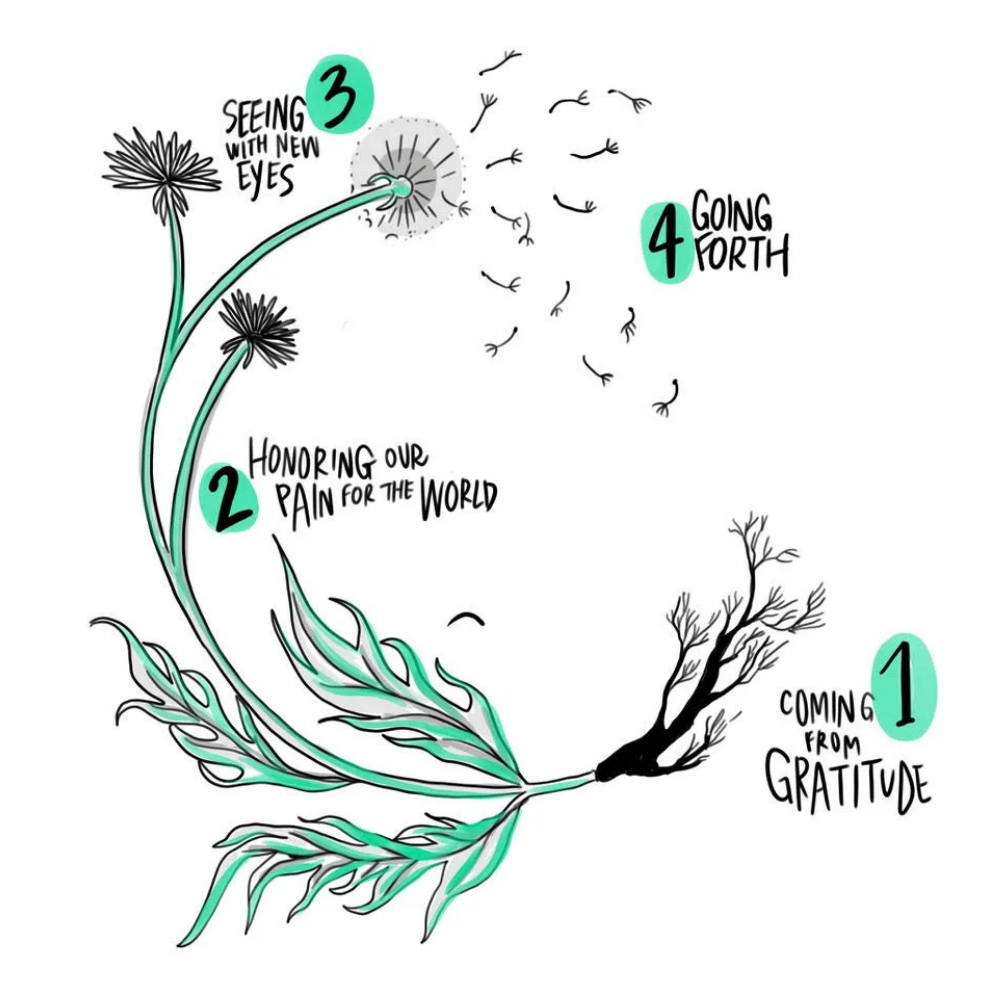
Image from the Work that Reconnects
Passive Hope (also sometimes called 'hopium') is considered a damaging concept. This is because it promotes passive waiting for a future saviour (government, technology, or a miracle) and distracts us from analysing underlying systemic and structural inequalities.
It results in individuals remaining optimistic in the face of ecological collapse, ongoing violence, and other atrocities. It also allows spiritual bypassing, promotes greenwashing, and leads to the continuation of business as usual, no matter how detrimental that might be.
Active Hope, on the other hand, involves taking a clear view of what is happening and acknowledging the severity of the situation. This includes personal and collective fear, pain, and struggles.
It also asks us to understand: what do I hope for, and what would I like to happen (for example, healing or the introduction of a new value system)? Once this takes place, it becomes possible to move forward with both intention and direction.
As Joanna Macy and resilience trainer, coach and author Chris Johnstone said in their joint work, Active Hope:
“Active Hope is a practice. Like tai chi or gardening, it is something we do rather than have. It is a process we can apply to any situation, and it involves three key steps. First, we take a clear view of reality; second, we identify what we hope for in terms of the direction we’d like things to move in or the values we’d like to see expressed; and third, we take steps to move ourselves or our situation in that direction.”
How to enable transformation
The WTR offers several stages to facilitate this transformation:
Gratitude: Recognising and giving thanks for the beauty and gifts life offers grounds us in the here and now. In our industrial growth-based society, this could well be the most subversive act of all as it counteracts consumerism and its constant imposition of craving and the need for more. This is our first expression of love for the world.
Honouring our pain for the world: Acknowledging and validating feelings of despair, anger, and grief. These are signs of misalignment, a further expression of our love for the world, and our grief over what is or might be lost.
Seeing with new/ancient eyes: Gaining new perspectives and insights and reconnecting with ancient wisdom. Understanding that we are not separate from nature. Recognising that the global crisis is, at root, a crisis of perception. There is no technological fix.
Going forth: Taking constructive action within the context of the insights gained. Being there to play our part.
As Joanna Macy and Chris Johnstone again point out in Active Hope:
“Since Active Hope doesn’t require our optimism, we can apply it even in areas where we feel hopeless. The guiding impetus is intention; we choose what we aim to bring about, act for, or express. Rather than weighing our chances and proceeding only when we feel hopeful, we focus on our intention and let it be our guide.”perception.